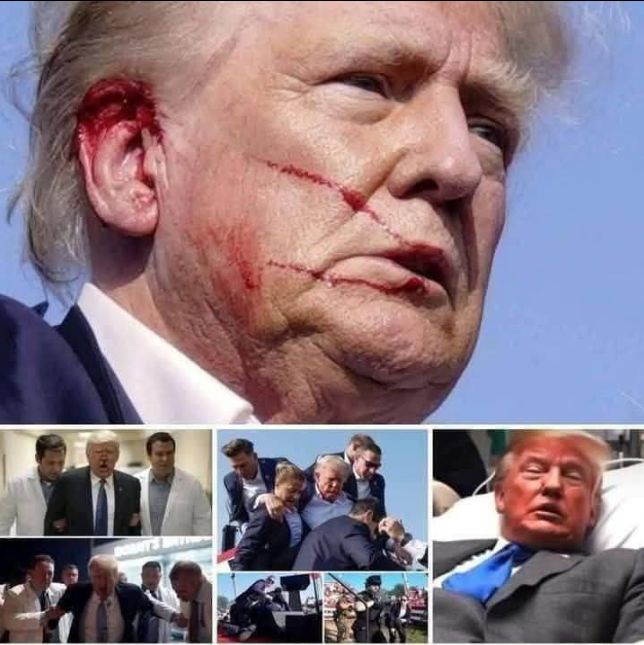
The image is arresting at first glance: blood streaked across a face familiar to millions, a rigid jaw set not in fear but in shock, and eyes fixed somewhere beyond the frame as if trying to comprehend how quickly everything changed. In a single instant, a public event meant to project strength and momentum transformed into a moment of vulnerability that reverberated far beyond the scene itself. It was not just an attack on one individual—it was a collision between violence and democracy, a reminder of how fragile public life can be even in the most powerful nations on Earth.
The incident unfolded with terrifying speed. One moment, the atmosphere was loud, energized, and ritualistic—supporters gathered, cameras rolling, security scanning the crowd. The next, chaos erupted. The sharp crack that cut through the air was not immediately understood by everyone present. Some thought it was a firework. Others froze, unsure whether to run or drop. Within seconds, reality asserted itself. Security personnel surged forward, bodies forming a human shield as confusion and fear rippled outward through the crowd.
The injuries, though not immediately understood, were visible enough to send shockwaves through social media and newsrooms worldwide. Blood, even when not life-threatening, carries immense symbolic power. It signals danger, mortality, and the sudden collapse of the illusion of control. Images spread faster than facts, and within minutes, the world was watching a near-death moment replayed from every angle—slowed down, zoomed in, analyzed frame by frame.
What made this moment so destabilizing was not only the violence itself, but the target. A former U.S. president is more than a political figure; he is a symbol, to supporters and critics alike, of an era, a movement, and a deeply polarized national conversation. An attack on such a figure is inevitably interpreted as an attack on the system he represents. That is why reactions poured in from every corner of the globe—statements condemning violence, calls for unity, and renewed debates about political rhetoric and public safety.
In the immediate aftermath, the focus shifted to survival. Medical professionals acted quickly, assessing injuries, stabilizing vital signs, and ensuring that no further harm had occurred. The difference between life and death in such moments is often measured in inches and seconds. That reality, stark and sobering, became the dominant narrative as updates confirmed that the injuries, while serious, were not fatal. Relief spread almost as quickly as panic had earlier, though it was tempered by a lingering sense of disbelief.
For those who witnessed the incident firsthand, the memory will not fade easily. Public gatherings are built on an unspoken contract of safety—a trust that while disagreements may be fierce, violence will remain outside the perimeter. When that contract is broken, it leaves behind more than physical damage. It fractures confidence. Attendees later described the sound, the screams, the sudden stampede of movement. Some recalled clutching strangers, others ducking instinctively, all of them aware that they had come dangerously close to becoming collateral damage in a moment that would be replayed for years.
The political implications were immediate and complex. Supporters framed the survival as evidence of resilience, even destiny, while opponents urged restraint and rejected any glorification of violence. Analysts debated whether the incident would harden existing divisions or force a moment of collective reckoning. History offers no simple answers. Similar moments in the past have sometimes united nations in grief and resolve, and at other times deepened fault lines already stretched to their limits.
Beyond politics, the incident reignited conversations about security in the modern age. How does one protect public figures in an era of constant exposure, where rallies are broadcast live and locations are announced in advance? How does security adapt to lone actors, rapidly evolving threats, and the amplification effect of online extremism? Each question underscores the uncomfortable truth that absolute safety is an illusion, even with layers of protection and planning.
Yet perhaps the most enduring impact of this near-death moment lies in its human dimension. Stripped of titles and power, the injured figure became, if only briefly, a reminder that public leaders are mortal. Blood does not discriminate between ideologies. Pain does not recognize party lines. In that instant, the distance between the individual on stage and the millions watching from afar narrowed to something profoundly human: vulnerability.
As images continue to circulate, they will be interpreted and reinterpreted, used to support narratives both sincere and cynical. But beneath the noise, the core truth remains unchanged. History almost took a different path that day. A fraction of an inch, a slightly altered angle, or a delayed response could have rewritten the political landscape overnight. That knowledge lingers, unsettling and unavoidable.
A near-death moment does not end when the bleeding stops. It echoes in conversations, in policy discussions, and in the collective memory of a society forced to confront its own volatility. Whether this moment leads to reflection, reform, or further division is a question that only time can answer. What is certain is that for one brief, terrifying stretch of seconds, the world held its breath—and in that silence, the fragility of public life was laid bare.