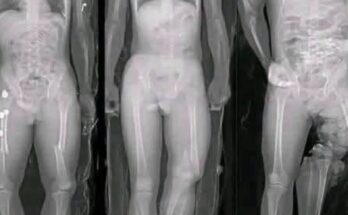

At first glance, it doesn’t make sense. Your eyes land on the image—or the moment, or the situation—and your brain does what it always does: it tries to categorize, to label, to understand. But something doesn’t fit. The shapes seem familiar, yet misplaced. The context feels real, yet strangely distorted. You pause, maybe squint a little, and the thought slips in almost involuntarily:
That moment—confusion mixed with curiosity—is more powerful than it seems. It’s the instant when perception and reality stop aligning perfectly, when your brain’s usual shortcuts fail, and you’re forced to actually see instead of just recognize.
Our minds are built for efficiency. Every day, we process thousands of visual cues without thinking. A chair is a chair. A face is a face. A shadow is just a shadow. We don’t analyze these things—we identify them instantly based on past experience. But when something disrupts that pattern, even slightly, it creates a kind of cognitive friction. And that friction is fascinating.


Maybe it’s a photograph taken at just the right angle, where a person appears to be holding up the moon between their fingers. Or a reflection in a mirror that makes a room look impossibly large. Or an object placed so perfectly in the foreground that it blends seamlessly with something in the background. Suddenly, your brain is juggling multiple interpretations at once, unsure which one to settle on.
That’s the magic of perspective.
What you’re seeing isn’t necessarily wrong—it’s just incomplete. The camera, or your point of view, has flattened a three-dimensional world into a two-dimensional frame. Depth disappears. Scale becomes ambiguous. Distance is compressed. And in that flattening, illusions are born.
Think about how often we rely on context to understand what we see. A tiny object up close can look massive if there’s nothing nearby to compare it to. A giant structure in the distance can seem small if the foreground dominates your vision. Without context, your brain fills in the gaps—and sometimes, it guesses wrong.
But it’s not just about visuals. The same thing happens in life.
There are moments when you walk into a situation—maybe a conversation, a decision, or even a memory—and nothing quite adds up. You think you understand what’s happening, but something feels off. The more you look at it, the less clear it becomes. And you’re left with that same quiet question:
What am I even looking at?
It’s uncomfortable, but it’s also an opportunity.
Because confusion forces you to slow down. It makes you question your assumptions. It pushes you to look from another angle—literally or figuratively. And often, when you do, the picture changes completely.
That strange image you couldn’t understand? Step a little to the side, and suddenly it clicks. What looked like chaos becomes clarity. What seemed impossible becomes obvious. The illusion doesn’t disappear—you just learn how to see through it.
There’s something deeply human about that process. We like certainty. We like things to make sense. But the world isn’t always neat and predictable. Sometimes it’s messy, layered, and misleading. And in those moments, our first interpretation isn’t always the right one.
In fact, it rarely is.
That’s why those confusing, head-scratching moments stick with us. They break the autopilot mode we live in. They demand attention. They invite curiosity. And most importantly, they remind us that perception is not the same as truth.
Two people can look at the exact same thing and see something completely different. One might see a trick of light; the other might see a hidden pattern. One might dismiss it as meaningless; the other might find it profound. Neither is necessarily wrong—they’re just seeing from different perspectives.
And perspective is everything.
It shapes how we interpret the world, how we understand others, and even how we see ourselves. Change the angle, and the meaning changes. Shift the context, and the story transforms. What once seemed confusing can become clear—or even beautiful.
So the next time you find yourself staring at something and thinking, What am I even looking at?, don’t rush to move on. Sit with that feeling for a moment. Let the confusion exist without immediately trying to resolve it.
Look closer.
Look differently.
Ask questions.
Because sometimes, what you’re seeing isn’t meant to be understood instantly. Sometimes it’s meant to challenge you, to stretch your perception, to remind you that there’s more than one way to see the same thing.
And occasionally, the answer isn’t hidden at all—you just haven’t found the right angle yet.
In a world that constantly pushes for quick answers and instant understanding, there’s something quietly powerful about not knowing. About pausing in that uncertain space and allowing yourself to explore it.
Because in that pause, something shifts.
Your mind opens.
Your perspective widens.
And what once looked like nonsense starts to form a pattern.
So maybe the better question isn’t What am I even looking at?
Maybe it’s:
What am I missing?
And that question—simple as it is—has the power to change everything.