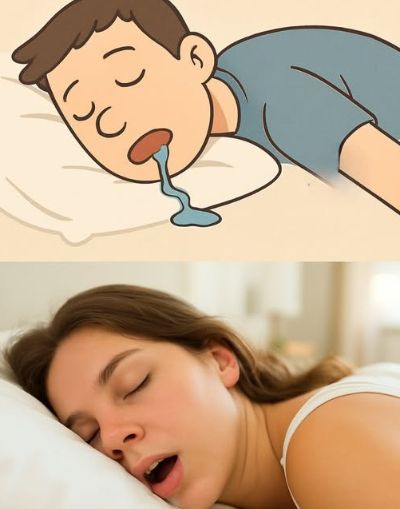

That kind of claim—“if you drool while you sleep, it means your brain is…”—is another classic example of a catchy statement that sounds scientific but doesn’t really hold up when you look at how the body actually works. It’s the kind of thing that spreads quickly because it feels like a hidden insight into your health, when in reality the explanation is much more straightforward and far less mysterious.
Drooling during sleep, also called nighttime salivation, is usually not a sign of anything unusual about your brain. In most cases, it comes down to simple physical factors like muscle relaxation, sleep position, and how your body manages saliva when you’re unconscious.
When you fall asleep, your body shifts into a more relaxed state. Muscles throughout your body loosen, including those in your face and mouth. During the day, you swallow saliva automatically without even thinking about it. It’s a constant, unconscious process controlled by your nervous system. But when you’re asleep—especially in deeper stages—your swallowing reflex slows down.
At the same time, if your mouth is slightly open, gravity can do the rest. Saliva that would normally be swallowed instead collects and may leak out, leading to drooling. This is particularly common if you sleep on your side or stomach, where there’s nothing stopping saliva from escaping your mouth.
So rather than being a sign of something happening inside your brain, drooling is often just about what’s happening with your muscles and positioning outside of it.
That said, there are a few factors that can make drooling more likely. One of the most common is nasal congestion. If your nose is blocked—due to a cold, allergies, or sinus issues—you’re more likely to breathe through your mouth while sleeping. Mouth breathing increases the chance of drooling because your lips stay open for longer periods.
Sleep quality can also play a role. When you enter deeper stages of sleep, your body becomes more relaxed overall. Some people who sleep very deeply may be more prone to drooling simply because their swallowing reflex is less active during those stages. Ironically, in some cases, drooling can actually be associated with good sleep rather than a problem.
There are also certain medical conditions that can contribute to increased drooling, but these are less common and usually come with other noticeable symptoms. For example, issues that affect muscle control or nerve function can interfere with swallowing. However, if drooling is your only symptom, it’s very unlikely to be related to anything serious involving the brain.
Medications can be another factor. Some drugs increase saliva production or affect muscle control, which can lead to drooling as a side effect. Again, this is more about chemical and physical responses in the body than any hidden signal about brain performance or intelligence.
One thing that’s important to clear up is the myth that drooling is a sign of being “deeply relaxed,” “mentally exhausted,” or “highly intelligent.” These ideas don’t have scientific backing. While relaxation does play a role in muscle behavior during sleep, there’s no evidence linking drooling to intelligence, brain power, or cognitive function.
It’s easy to see why people are drawn to those explanations, though. Humans naturally look for meaning in small, everyday behaviors. A simple thing like drooling feels more interesting if it’s framed as a secret clue about your brain. But in reality, most of these viral claims are just creative storytelling rather than actual science.
If drooling happens occasionally, it’s completely normal and nothing to worry about. Many people experience it at some point, especially when they’re very tired, sleeping in a new position, or dealing with temporary congestion.
However, if it becomes excessive or starts happening suddenly and frequently, it might be worth paying attention. Not because it signals something dramatic about your brain, but because it could point to more practical issues like chronic nasal blockage, sleep apnea, or difficulty swallowing. In those cases, it’s less about the drooling itself and more about what might be causing it.
There are also simple ways to reduce drooling if it bothers you. Adjusting your sleep position—like sleeping on your back—can help keep saliva from escaping. Addressing nasal congestion with proper treatment can also make a difference. Staying hydrated and maintaining good oral health can support normal saliva regulation as well.
In the end, the real explanation is much less dramatic than the viral claim suggests. Drooling while you sleep isn’t a secret message from your brain—it’s just a small side effect of how your body relaxes and functions during rest.
So if you wake up with a little drool on your pillow, it doesn’t mean anything profound about your mind. It just means you were asleep, your muscles were relaxed, and gravity did what gravity always does