 BREAKING NEWS: Viral Claim About Savannah Guthrie’s Family — What’s Real and What Isn’t
A headline has been circulating rapidly online:
“Nancy Guthrie, 84, mother of Savannah Guthrie, was found dead, and her stepfather…”
It’s the kind of message designed to stop you mid-scroll. It suggests tragedy, mystery, and possibly even something criminal. But before diving into the emotional weight of such a claim, it’s important to pause and examine what is actually known—and what may simply be misinformation spreading online.
 Who Is Savannah Guthrie?
To understand why this story is gaining traction, it helps to know who Savannah Guthrie is.
She is:
- A well-known American journalist
- Co-anchor of NBC’s Today show
- A public figure with millions of viewers who follow her career and personal life
Because of her visibility, any news—especially tragic or shocking news—connected to her or her family spreads extremely quickly.
That’s part of the problem.
 The Claim Itself
The viral post makes several strong implications:
- That her mother, Nancy Guthrie, has died
- That she was “found dead,” suggesting unusual or suspicious circumstances
- That her stepfather may somehow be involved
These are serious claims—the kind that would normally be covered immediately by major news organizations if they were true.
But here’s the critical point:
 There is no confirmed, credible report verifying this story.
 What Can Be Verified
As of now:
- No major, reliable news outlets have reported the death of Savannah Guthrie’s mother
- There are no official statements from Savannah Guthrie or her representatives confirming such an event
- There is no verified information linking any “stepfather” to a crime or incident
In situations involving public figures, especially tragedies, credible reporting tends to appear quickly and consistently across multiple sources.
That has not happened here.
 How These Stories Spread
This type of headline follows a familiar pattern often seen on social media:
- A recognizable name — Savannah Guthrie
- A shocking claim — death under unclear circumstances
- A hint of mystery or wrongdoing — “and her stepfather…”
- A cliffhanger — encouraging users to click or search for more
The goal is simple:
Grab attention and generate engagement
Unfortunately, accuracy often comes second.
 Why Misinformation Like This Is Harmful
Even if shared without bad intentions, posts like this can cause real damage:
- Emotional distress for the person involved and their family
- Reputational harm to individuals mentioned without evidence
- Confusion and fear among the public
Imagine seeing false reports about your own family spreading online—it’s not just misleading, it’s deeply personal.
 The “Stepfather” Angle
One of the most concerning parts of the headline is the vague reference to a stepfather.
This is a common tactic in misleading posts:
- Introduce a second person
- Suggest involvement without evidence
- Leave the reader to assume something criminal
Without verified facts, this kind of implication is pure speculation.
And speculation, when presented as breaking news, becomes misinformation.
 Why People Believe It
There are a few reasons why headlines like this feel believable:
1. Familiar Names
People recognize Savannah Guthrie, so the story feels legitimate at first glance.
2. Emotional Impact
Words like “found dead” trigger a strong reaction, making people more likely to click or share.
3. Urgency
“BREAKING NEWS” creates the illusion that you’re seeing something important before others.
4. Lack of Immediate Context
When you don’t see full details, your brain tries to fill in the gaps—often assuming the worst.
 What You Should Do When You See Claims Like This
Instead of reacting instantly, it helps to take a few simple steps:
- Check for confirmation from major, reputable news sources
- Look for official statements from the person or their representatives
- Be cautious of vague or incomplete headlines
- Avoid sharing unverified information
In today’s digital world, not every “breaking news” post is actually news.
The Reality
Let’s be clear:
There is no verified evidence that Nancy Guthrie has died under suspicious circumstances There is no confirmed report involving a stepfather in any incident The story appears to be unverified and likely misleading
 Final Thought
Headlines like this are designed to pull you in:
A well-known figure
A sudden tragedy
A hint of mystery
But real news doesn’t rely on half-sentences and cliffhangers like “see more in comment.”
It relies on facts, confirmation, and accountability.
Before believing or sharing something like this, it’s worth asking a simple question:
Is this actually being reported anywhere credible—or is it just being repeated?
Because in many cases, the difference between truth and misinformation is just one click away—but the impact of spreading it can last much longer.
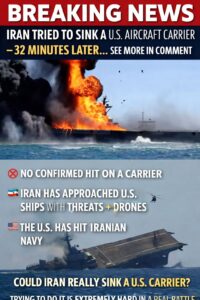
BREAKING NEWS? Or Viral Illusion? The Truth Behind the “Aircraft Carrier Attack” Image
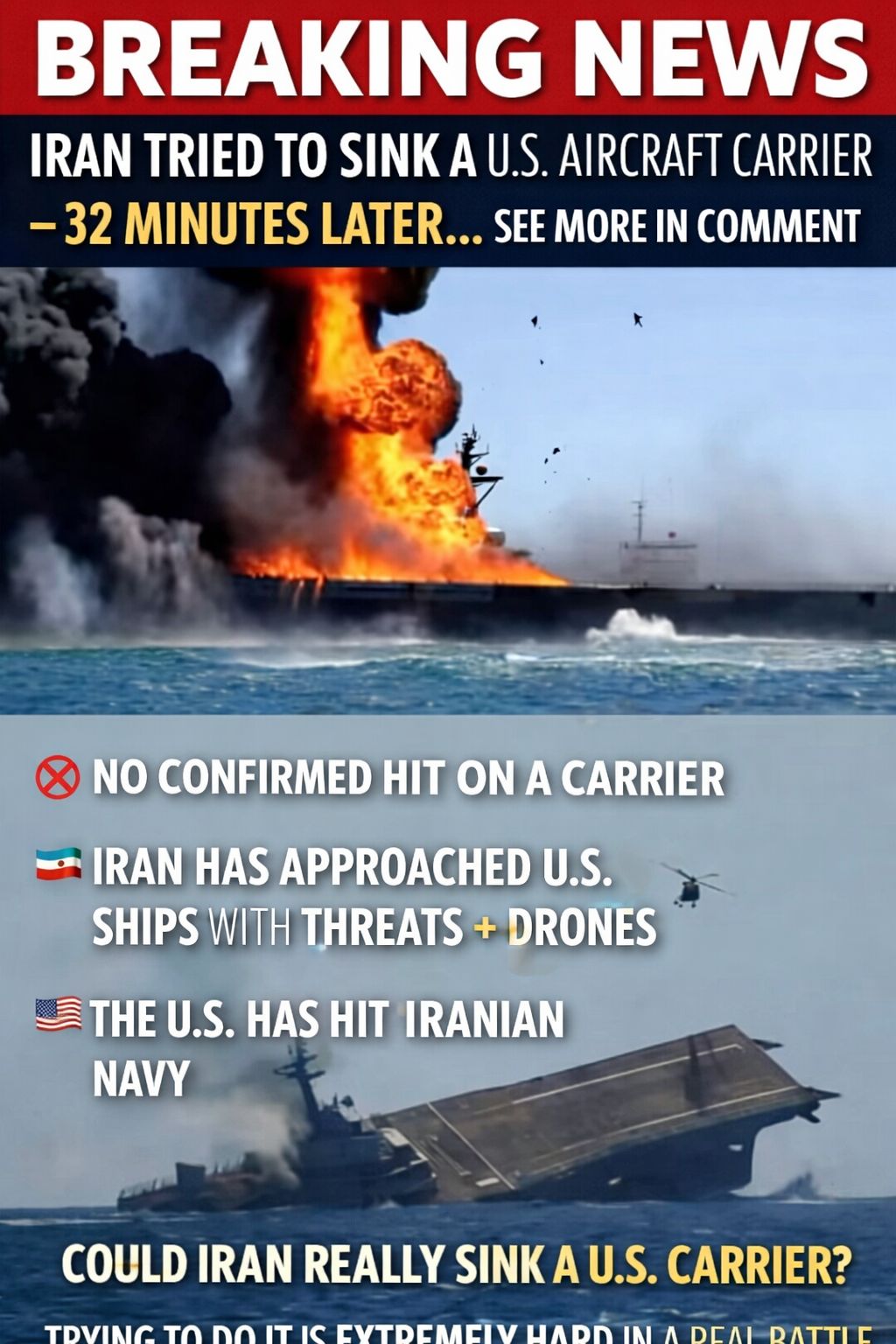
At first glance, the image is overwhelming.
A massive fireball erupts from the deck of what appears to be a U.S. aircraft carrier. Thick black smoke billows into the sky. Flames tear through the structure. In the lower frame, another carrier tilts dramatically into the sea, its flight deck angled downward as if it is moments away from sinking. A helicopter hovers nearby, reinforcing the sense of urgency and disaster.
Above it all, bold text screams:
“BREAKING NEWS — Iran Tried to Sink a U.S. Aircraft Carrier — 32 Minutes Later…”
It’s dramatic. It’s cinematic. It feels real.
But the key question is:
Is it actually real?
First Impressions vs. Reality
Images like this are designed to trigger a reaction before you even have time to think.
- Fire = danger
- Warship = military conflict
- Explosion = attack
- “Breaking news” = urgency
Your brain immediately connects the dots and assumes:
A U.S. aircraft carrier was attacked and possibly destroyed.
But when you slow down and analyze it, several red flags appear.
 The Visual Clues
Let’s break down what we’re actually seeing:
1. The Explosion
The explosion in the top half is unusually large and dramatic—more like something out of a Hollywood film than a real naval strike.
Real-world naval explosions:
- Are often more contained
- Occur at specific impact points
- Rarely engulf an entire carrier deck in one instant fireball
This looks more like a composite or staged visual than a real-time combat photo.
2. The Sinking Carrier
The lower image shows a carrier tilted at a steep angle, partially submerged.
Here’s the issue:
- Aircraft carriers are built with multiple watertight compartments
- They are designed to resist sinking even after severe damage
- A sudden dramatic tilt like this is extremely rare in modern naval incidents
In reality, sinking a carrier would likely take:
- Multiple successful strikes
- Prolonged damage
- Hours—or even days
Not a sudden cinematic collapse.
3. The Helicopter Detail
The helicopter hovering nearby adds realism—but also raises questions.
In an actual catastrophic strike:
- Airspace would be chaotic
- Rescue operations would be coordinated, not isolated
- Multiple aircraft and ships would be visible
Instead, this looks like a carefully composed scene meant to feel believable.
The Psychology Behind the Headline
The text plays just as important a role as the image.
“32 minutes later…”
This is a classic psychological hook. It creates:
- Suspense
- Curiosity
- A sense that something shocking is hidden
Combined with:
“See more in comment”
…it becomes a click trap.
The goal is not to inform—it’s to make you:
- Click
- Share
- Engage
The Contradiction Inside the Image
Interestingly, the image itself contains a contradiction.
It says:
 “No confirmed hit on a carrier”
 Iran has approached U.S. ships with threats and drones
 The U.S. has hit Iranian navy
So even within the graphic, the message is unclear.
It suggests something dramatic happened Then quietly admits there is no confirmed carrier strike
This is a common tactic:
- Grab attention with a bold claim
- Soften it with vague disclaimers
 What’s Actually True
There are real tensions between the United States and Iran.
Verified patterns include:
- Iranian drones approaching U.S. naval vessels
- U.S. forces intercepting or destroying those drones
- Occasional naval confrontations in strategic waters
These are serious—but they are not the same as:
A U.S. aircraft carrier being destroyed
 The Reality of Aircraft Carriers
To understand why this matters, consider what an aircraft carrier represents.
A U.S. carrier is:
- One of the most heavily defended military assets in the world
- Protected by destroyers, submarines, and aircraft
- Equipped with advanced radar and missile defense systems
Attacking one successfully would require:
- Coordinated missile barrages
- Electronic warfare
- Precise targeting under heavy defense
Even then, success is far from guaranteed.
 Why Images Like This Spread So Fast
This kind of content spreads rapidly because it combines:
1. Fear
War, explosions, and destruction trigger instinctive reactions.
2. Curiosity
The “32 minutes later” hook makes you want to know what happened next.
3. Simplicity
It reduces a complex geopolitical situation into a single dramatic moment.
4. Visual Impact
An image is more powerful than text—and harder to question in the moment.
Reality vs. Viral Narrative
Let’s break it down clearly:
What the image suggests:
- A major Iranian attack
- A U.S. carrier nearly destroyed
- A dramatic aftermath
What’s actually supported by evidence:
- Rising tensions and military activity
- Drone encounters and naval posturing
- No confirmed destruction of a U.S. aircraft carrier
The Bigger Picture
The most important thing to understand is this:
The situation in the world is already serious enough without exaggeration.
When real tensions exist, misinformation becomes more powerful because it feels believable.
But that also makes it more dangerous.
False or exaggerated claims can:
- Increase panic
- Spread confusion
- Distort public understanding of real events
Final Thought
The image is designed to feel like a moment from history:
A massive explosion
A sinking warship
A countdown to something shocking
But in reality, it’s something else entirely:
A blend of dramatic visuals, partial truths, and misleading framing
It doesn’t show a confirmed event.
It shows how easily perception can be shaped.
So the next time you see something like this, ask yourself:
- Who created it?
- What is it trying to make me feel?
- And most importantly…
- Where is the actual evidence?
Because in today’s world, not everything that looks real… actually is.