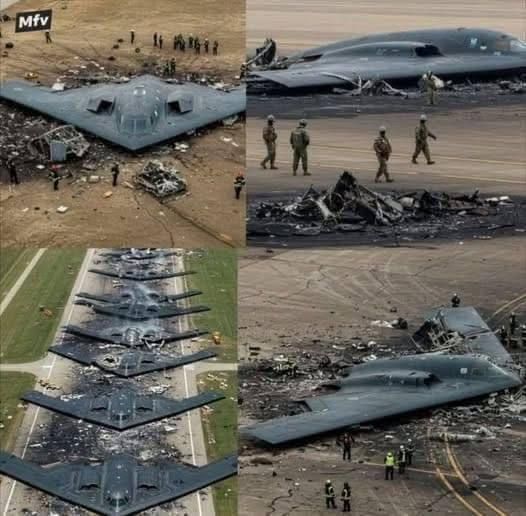

In a powerful demonstration of modern aviation capability, the United States Air Force recently carried out an extended-duration mission involving the iconic B-2 Spirit stealth bomber. While headlines often focus on distance or flight time, the true significance of such operations lies deeper—in the precision planning, sustained performance, and seamless coordination required to execute missions that can span continents without interruption.
These flights are not just about how far an aircraft can travel, but how effectively it can operate under demanding conditions for extended periods. They reflect a level of technological sophistication and human endurance that defines modern airpower.
Long-duration missions like this represent a major achievement in military aviation. Unlike conventional flights, which may rely on nearby bases for support, these operations are designed to project power globally from a limited number of locations. This capability reduces dependence on forward bases and allows for rapid response across vast distances.
At the heart of such missions is meticulous coordination. Every detail is planned in advance, from flight paths and fuel requirements to communication protocols and contingency scenarios. One of the most critical components is aerial refueling. Tanker aircraft must meet the bomber at precise locations and times, often multiple times during a single mission, to ensure it can remain airborne for extended periods.
Navigation also becomes more complex. The aircraft may pass through multiple airspaces, requiring careful coordination with different control systems while maintaining operational security. All of this must be done without compromising the aircraft’s stealth characteristics.
The B-2 Spirit is uniquely suited for these challenges. Designed with advanced stealth technology, it can penetrate heavily defended airspace with minimal detection. Its flying-wing design reduces radar signature, while specialized materials and coatings absorb and deflect radar waves. This allows it to operate in environments where other aircraft might be at greater risk.