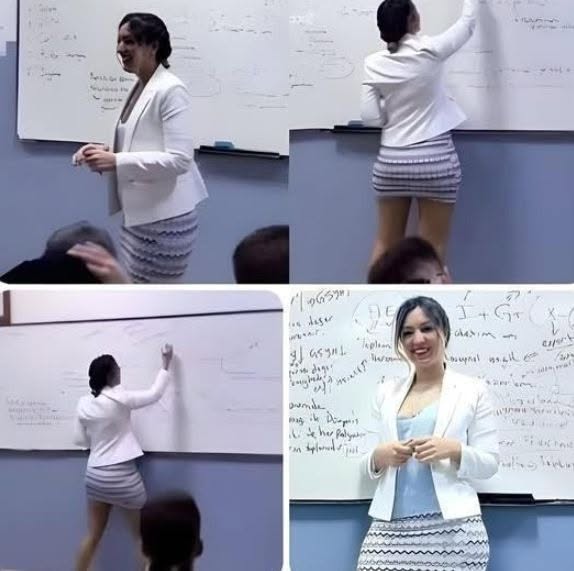
The story broke on a gray Tuesday morning, the kind that usually passed without notice. But by noon, it was everywhere—shared, reshared, argued over, and dissected in comment sections that moved faster than the facts themselves.
“Teacher expelled for PROVOKING her students and forcing them… See more.”
That was the headline.
It was vague enough to spark curiosity, dramatic enough to invite outrage. Within hours, people had already made up their minds about what had happened inside Room 214 at Brookdale High.
But the truth, as it turned out, was far more complicated—and far more human.
Her name was Elena Ruiz.
She had been teaching literature for nearly fifteen years. Not the kind of teacher who handed out worksheets and waited for the bell, but the kind who asked questions that lingered long after class ended.
“What does this story say about who we are?” she would ask, pacing slowly between desks.
“Not the characters—you.”
Some students loved her.
Others found her uncomfortable.
Because Elena didn’t just teach books. She challenged people.
The trouble began during a unit on personal narratives.
Instead of assigning a traditional essay, Elena introduced something different.
“I want you to write about a moment that changed you,” she told the class. “Something real. Something that made you question who you are—or who you thought you were.”
A few students shifted uneasily.
One raised his hand. “Does it have to be… personal?”
Elena paused.
“It doesn’t have to be traumatic,” she clarified. “But it should be honest.”
That word—honest—hung in the air.
At first, the assignment seemed like any other.
Students typed quietly, some more engaged than usual. A few even stayed after class to ask for feedback, something that rarely happened with standard essays.
But as the days went on, tensions began to surface.
One student, Marcus, refused to participate.
“I’m not writing about my life,” he said flatly when Elena approached his desk.
“That’s okay,” she replied calmly. “You can choose something you’re comfortable sharing.”
“I’m not comfortable sharing anything.”
Elena nodded, but didn’t walk away immediately.
“Then maybe the assignment isn’t about sharing,” she said gently. “Maybe it’s about understanding.”
Marcus didn’t respond.
But the exchange didn’t go unnoticed.
Later that week, a parent email landed in the school’s inbox.
“My child feels pressured to reveal personal information in class. This is inappropriate.”
It was the first of several.
Some students had interpreted the assignment not as an invitation, but as an expectation. Others felt that discussions in class had gone too far—too personal, too probing.
One student wrote anonymously in a feedback form:
“She keeps asking us why we think the way we do. It feels like she’s trying to get inside our heads.”
The administration took notice.
At first, it was handled quietly. A meeting. A reminder about boundaries. A suggestion to offer alternative assignments more clearly.
Elena listened.
“I never intended to force anyone,” she said. “I wanted them to think critically about themselves and the world.”
“We understand,” the principal replied. “But perception matters. Students need to feel safe—not exposed.”
But the situation escalated.
A video clip surfaced online—taken by a student during class.
It showed Elena standing at the front of the room, asking a student to elaborate on their essay.
“Why do you think that moment affected you so deeply?” she asked.
The student hesitated.
“I don’t know… it just did.”
Elena stepped closer, her tone still calm but more insistent.
“Sometimes ‘I don’t know’ is where the real answer begins.”
The clip ended there.
Out of context, it looked different.
To some, it appeared she was pushing too hard. Crossing a line.
Within hours, the video spread.
The headline grew louder.
By the end of the week, Elena was called into another meeting—this time more formal.
“This has become a larger issue,” the principal said, sliding a printed page across the table.
It was a compilation of complaints.
Words like “pressure,” “discomfort,” and “inappropriate” appeared repeatedly.
Elena read them slowly, her expression unreadable.
“I was trying to teach them to think,” she said quietly.
“And some feel they were being pushed to reveal more than they wanted,” the principal replied.
There was a long silence.
The decision came two days later.
Elena Ruiz was removed from her position.
The official statement used careful language:
“Due to concerns regarding classroom practices and student well-being, the school has decided to terminate Ms. Ruiz’s employment effective immediately.”
But online, the narrative was far less measured.
“Teacher EXPLOITED students.”
“Classroom turned into therapy session.”
“Lines were crossed.”
The word provoking was repeated again and again.
Students reacted in different ways.
Some felt relieved.
“I didn’t like how personal it got,” one said. “It felt like we didn’t have a choice.”
Others were confused.
“She was the only teacher who actually cared about what we thought,” another argued.
Marcus, the student who had refused the assignment, didn’t speak publicly.
But he turned in a paper the following week—after Elena was gone.
It was short. Just one page.
At the top, it read:
I didn’t want to write this before because I didn’t think it mattered. But maybe it did.
The story didn’t end with the headlines.
A few weeks later, a longer article surfaced—one that included student interviews, full context, and perspectives that hadn’t made it into the viral posts.
It painted a more complicated picture.
A teacher who pushed boundaries—not maliciously, but perhaps without fully recognizing how different students would experience it.
A classroom that encouraged honesty—but didn’t always account for how vulnerable honesty can feel.
A system trying to balance growth with protection—and struggling to find the line between them.
As for Elena, she didn’t give interviews.
But in a letter shared quietly among former colleagues, she wrote:
“I never wanted my students to feel unsafe. I wanted them to feel seen. If I failed to create that balance, then that’s something I have to learn from too.”
The headline had promised something shocking, something simple.
But the truth wasn’t simple.
It rarely is.
Because in the space between “provoking” and “teaching,” between “forcing” and “encouraging,” there’s a line—and sometimes, it’s thinner than anyone realizes.
And when that line is crossed, even with good intentions, the consequences don’t just belong to one person.
They ripple outward.
Through students. Through schools. Through conversations about what education should be—and what it should never become.